On what the creator economy taught a generation to sell — and what it quietly taught them to stop giving away.

Somewhere in the last decade, a generation of people who knew things were told to become creators. The instruction was specific, and it was repeated until it sounded like common sense: take what you know and turn it into a post, a thread, a video. Build an audience. Monetise the audience. The knowledge was raw material; the content was the product; the audience was the asset. It worked, for some. It also quietly broke something.
Knowledge does not become useful simply because it has been published.
Table of Contents
- The Average Reader Does Not Exist
- The Market That Was Never Built
- What Your Knowledge Is Actually Worth
- You Can Be Both
- You Do Not Have to Know Everything
- What We Are Actually Asking
- A Different Kind of Creator Economy
- We are opening CED to our first 100 pioneers.
The Average Reader Does Not Exist
A piece of content has to work for everyone who might see it. That is its defining constraint — the thing that makes it content rather than a conversation. It is written for the median reader, the average situation, the general case. But useful knowledge is almost never general. It is the thing that applies to your team, your constraint, your budget, the specific person who is blocking you, or the specific fear you have not said out loud to anyone.
Ask anyone who has spent time helping someone with a problem they know well, and they will tell you that having the answer is rarely the hard part. The hard part is figuring out what the other person actually needs. Sometimes a question reveals that they are stuck three steps earlier than you expected. Sometimes the problem they brought to you is not the problem they actually have. You have to ask, listen, adjust, and find a way in from where they are.
Content cannot do that. Content does not know who is reading it. A person does.
A course can explain how to start a company. A founder can look at your situation and tell you that your biggest problem is not your business model but the way you are trying to solve a hiring problem with a marketing strategy.
A tutorial can teach you how to use a design tool. A designer can look at your portfolio and tell you why the work feels unfinished.
A hundred videos can explain how to prepare for an interview, but someone who has actually hired for the role can spend thirty minutes looking at your answers and tell you which one is costing you the opportunity.
The difference is not always the information itself. It is knowing how that information applies to a specific person. And that is hard to do at scale.
The Market That Was Never Built
The creator economy has built a huge market for knowledge that can be packaged and sold to many people. Courses, newsletters, podcasts and online communities all make it possible to turn what you know into something that can reach thousands.
But there is much less infrastructure for something simpler: helping one person with one specific problem.
If someone needs exactly what you know right now, there is no obvious way for them to pay you for forty minutes of your time. Usually, it is a message, a favour, or a coffee that never gets scheduled. The knowledge is valuable, the person needs it, but there is no simple system connecting the two.
That is not because one kind of knowledge is worth more than the other. It is because one scales and the other does not. The creator economy naturally rewards knowledge that can be packaged, distributed and consumed by many people. Knowledge that is shared directly, in response to one person's situation, is harder to fit into that model.
And that leaves a lot of useful knowledge sitting outside the market. People answer questions, share advice, review someone's work and help solve problems every day. They do it because they know something that can make another person's path easier. But most of these exchanges happen informally, without a clear way to value or pay for them.
The problem was never that this knowledge had no value. We simply never built a good way to exchange it.
What Your Knowledge Is Actually Worth
This raises a simple question: how do you put a value on what someone knows?
How much should thirty minutes of advice cost? What is it worth if one conversation helps someone avoid a mistake that could have taken them six months to fix? And how do you price the experience of knowing which shortcut to take because you have already made the wrong turn?
We usually use time as the easiest way to measure value. One hour costs X, so two hours costs 2X. But more time does not always mean more value. Someone with deep expertise might solve a problem in twenty minutes that would take someone else two hours to figure out.
The value is not in how long the conversation lasts. It is in what the other person gets from it.
This is the idea Capacity Exchange starts from.
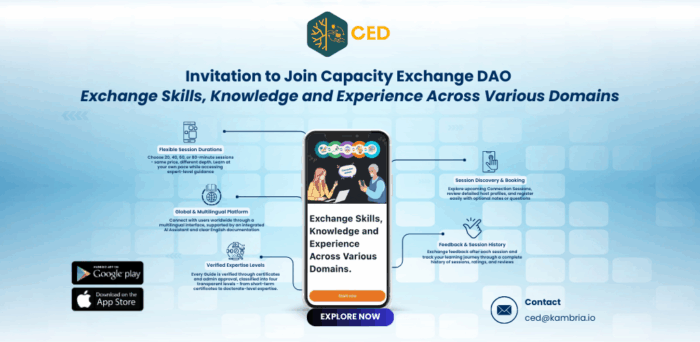
CED is a platform for live, one-to-one capacity exchange: one person with a real problem, one person with relevant experience, and twenty to fifty minutes to work through it together. Guides have verified expertise, with credentials such as certificates or degrees reviewed by a person, and their expertise level is shown on their profile before anyone books.
Then there is one detail in how CED prices sessions that captures the idea behind the whole model.
A Level 4 Guide — someone with doctoral-level expertise — offers a 20-minute session. A Level 1 Guide offers a 50-minute session. They cost the same.
We are used to paying for time. CED asks us to think about value differently. Someone with deeper expertise may be able to help you reach an answer in twenty minutes that would take someone else two hours to figure out. The session does not become more valuable simply because it lasts longer.
You are paying for expertise, not for time.
Attention is measured in minutes. Expertise is not.
And perhaps that is what the attention economy has struggled to value all along: not how long someone can hold your attention, but how much their experience can help you move forward.
You Can Be Both
The creator economy has also created a simple divide: creators on one side, audiences on the other. Experts and followers. The people who know and the people who watch.
But most people do not fit neatly into either category.
The person looking for advice about product design today might be the person helping someone with user research tomorrow. An operations lead might know everything about delegation and almost nothing about financial modelling. An engineer might be brilliant at solving technical problems and still need help navigating their career.
Knowing a lot about one thing does not mean knowing everything.
That is why on CED, you can be a Guide in one session and an Explorer in the next. You can come because there is something you need to explore, then return because there is something you know well enough to help someone else with.
The roles are not permanent. They move with what we know and what we need.
And that feels closer to how knowledge actually works.
You Do Not Have to Know Everything
There is one more assumption worth challenging: that you need to be an exceptional expert before your knowledge is worth sharing.
We often think of expertise as something that requires a PhD, twenty years of experience, a senior title, or a large audience. Sometimes those things matter. But you do not always need twenty years of experience to help someone who is two years behind you.
In fact, being only a few steps ahead can be useful because you still remember what it felt like to be at the beginning. You remember the false starts, the wasted months, the mistake nobody warned you about, and the shortcut you wish someone had shown you earlier.
If you learned something the hard way, someone else is probably at the beginning of that same road right now. They may not need the world's leading expert. They may just need someone who has already been where they are.
And they may never find you.
That is the problem we are trying to solve.
Not the monetisation of knowledge.
The meeting of it.
What We Are Actually Asking
CED is opening to its first 100 pioneers, and we are looking for people with knowledge worth exchanging.
For Guides, the path is deliberately simple. You begin with two sessions in volunteer mode. These sessions are unpaid by design: you learn the platform, someone gets real help, and both sides get to see whether the exchange works before money enters the picture.
After that, you become a verified Service Partner and can receive a pilot rate of US$6 per completed session.
There is no audience to build, no algorithm to feed, no posting schedule to maintain, and no personal brand to keep consistent. CED is not asking you to become a creator. You simply bring what you know to one person who needs it.
And then another.
That may sound smaller than the creator economy's promise of scale. Maybe it is. But smaller is not the same as less valuable.
A Different Kind of Creator Economy
The creator economy taught a generation to turn knowledge into content. It taught us how to package what we know, distribute it widely and measure its reach. Those are useful skills. But they are not the whole story.
Some knowledge should reach a thousand people. Some knowledge only becomes useful when it meets one.
The first requires distribution. The second requires exchange.
We have built remarkable systems for the first. We are still figuring out the second.
Capacity Exchange is trying to make that kind of exchange easier. Not by replacing content or asking everyone to become a creator, and not by promising that every piece of knowledge can become a source of income. Just by helping one person who needs something find someone who already knows it.
Your knowledge might not be worth a thousand views. It might be worth helping one person avoid a mistake that took you six months to recover from. It might be worth twenty minutes because you already know where to look.
Maybe the next step for the creator economy is not creating more content. Maybe it is giving knowledge a better way to reach people.
We are opening CED to our first 100 pioneers.
Capacity Exchange is a global exchange for skills, knowledge and experience — live 1-on-1 sessions, 20–50 minutes, with verified Guides. The session length reflects expertise level; the price is the same either way.
EXPLORER
- 2 free trial sessions
- Bring one real problem
- Leave with a next step
GUIDE
- 2 sessions in volunteer mode
- Then: verified Service Partner
- US$6 per completed session, pilot rate
Register as a Guide, an Explorer — or both