Table of Contents
- 1. DEP 1 Program Summary & Learnings
- 2. DEP 1 DAO Reflections & Highlights
- 3. Recognition & Appreciation
- 4. DEP 2 Overview & DAO Introduction
- 5. How to Join DEP 2 (Participants, Ambassadors & Partners)
- 6. Partner Perspectives & Open Roundtable
- 7. Open Q&A
- How does Kambria support DEP participants in turning early-stage DAO experiments into sustainable, real-world impact after the program ends?
- I’m interested in understanding how Community Partners can scale youth engagement across regions during DEP 2, and how proposed DAO ideas can integrate social impact themes such as public health, education, and youth development.
- 8. Next Milestones & Heartfelt Thanks
- - - - - 🔹 - - - - -
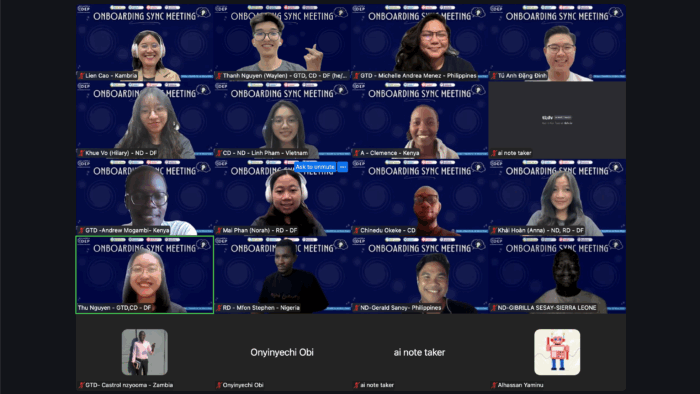
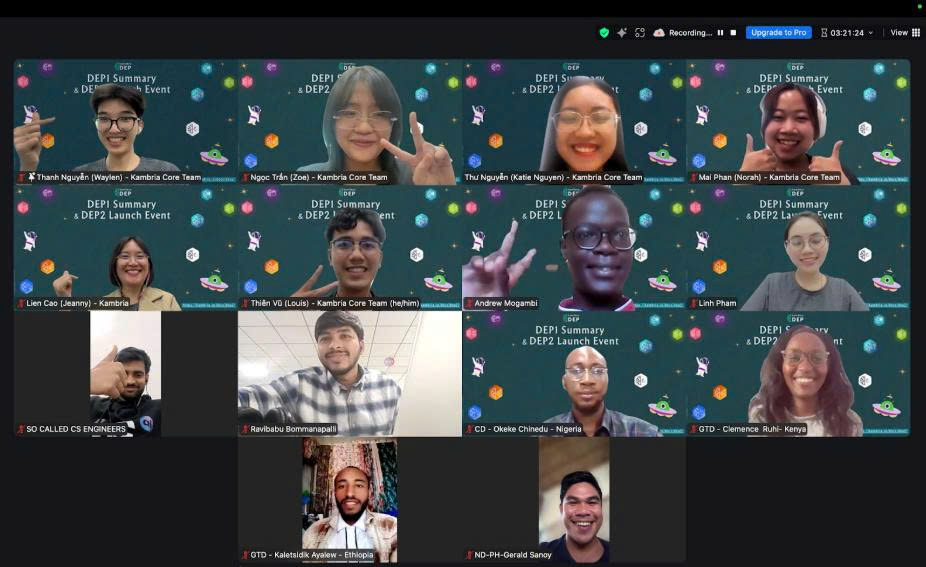
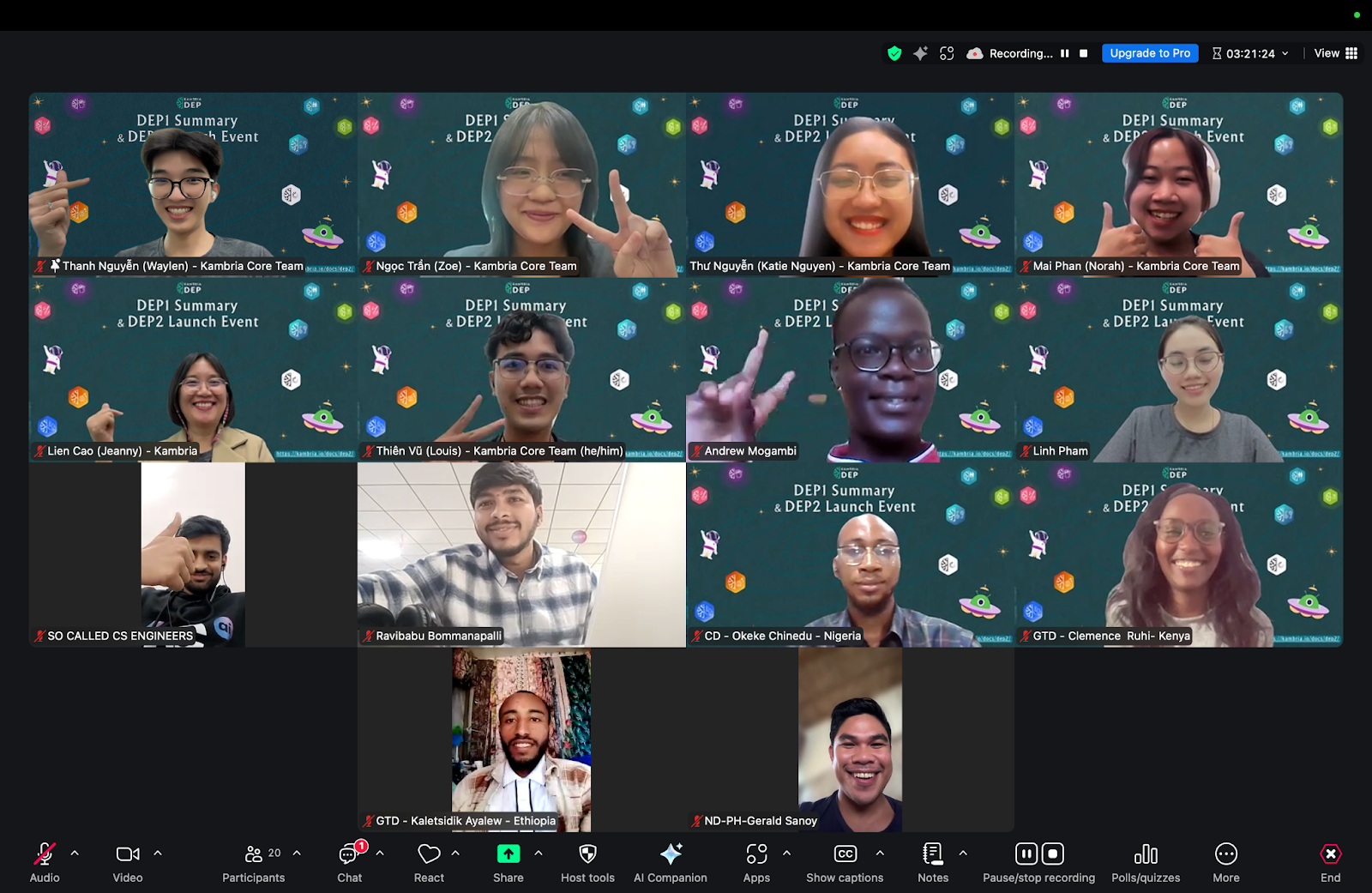
Kambria has successfully organized the DEP 1 Summary & DEP 2 Launch Event on Feb 06, 2026.
This Meeting marks a meaningful moment for Kambria as we close DEP 1 through reflection, real DAO learnings, and recognition of outstanding contributors, while introducing the direction and roadmap for DEP 2. We also present 4 new DAOs focused on sustainable regeneration and invite participants, ambassadors, and partners to explore collaboration and co-build the next phase together.
Key Highlights:
- DEP 1 Program Summary & Learnings
- DEP 1 DAO Reflections & Highlights
- Recognition & Appreciation
- DEP 2 Overview & DAO Introduction
- How to Join DEP 2 (Participants, Ambassadors & Partners)
- Partner Perspectives & Open Roundtable
- Open Q&A
- Next Milestones
Esteemed Attendees:
- Ms. Liên Cao - Kambria Core Team
- Kambria Team members: Thư Nguyễn, Mai Phan, Thanh Nguyễn, Thiên Vũ, Linh Phạm, Ngọc Trần
- DEP Partners: Mr. Amit Saha (FoGS Global Research & Consultancy Centre), Mr. Gibrilla Sesay (Founder and Executive Director of Heart of Home Foundation)
- DAO Members (Cohort 1 and Cohort 2)
Full video:
- - - - - 🔹 - - - - -
1. DEP 1 Program Summary & Learnings
The DEP 1 Summary session opened with a reflection on the original mission of the DAO Experimentation Program: to test whether DAO-based coordination could move beyond theory and deliver real, measurable social impact in the real world.
Over the course of DEP 1, the program received a total of 182 applications from participants across multiple regions, and deployed a combined fund size of 10,500 USDT, with each DAO operating within a funding range of 1,500 – 3,000 USDT. DEP 1 also collaborated with 6 implementation partners, who played a critical role in enabling on-the-ground execution and local coordination.
In terms of tangible impact, DEP 1 generated meaningful outcomes across four experimental DAOs:
- Nourish DAO distributed more than 1,500 meals to underserved communities.
- Grow Together DAO planted over 1,000 trees, contributing to environmental regeneration.
- Connect DAO successfully onboarded 15 seniors, expanding intergenerational connections.
- Reflection DAO collected about 50 reflections, documenting lived experiences from DAO members across countries.
These activities took place across diverse contexts, including Kenya, Sierra Leone, the Philippines, and Nigeria, demonstrating that DAO-based collaboration could operate effectively across geographic and cultural boundaries.
Overall, DEP 1 proved that decentralized coordination is not only conceptually viable, but also capable of producing real-world social outcomes when aligned with clear goals, committed communities, and localized partnerships.
However, beyond celebrating impact, the session emphasized that DEP 1 was also a learning experiment. Several operational challenges emerged, and these insights directly informed the design of DEP 2.
Key Learnings Shaping DEP 2:
a. From fragmented projects to DAO-first structure
- In DEP 1, each DAO was divided into two assigned project groups, running two separate proposals in parallel. While this helped test different ideas, it also led to fragmentation: teams were divided, coordination became heavier, and shared ownership was harder to build.
- Based on this learning, DEP 2 shifts to a DAO-first model. Each DAO now operates as one entity with one shared proposal, while members can self-organize into functional working groups (such as operations, outreach, content, or partnerships). This structure keeps everyone aligned around one impact and one regeneration goal, while still allowing multiple activities to happen in parallel.
b. From flexible participation to contribution-based governance
- In DEP 1, weekly DAO meetings were encouraged but optional, and active score did not affect decision-making. While this provided flexibility, it also meant that engagement and responsibilities were not always aligned.
- In DEP 2, weekly DAO meetings become compulsory, as DAOs only function when members consistently show up, coordinate, and deliver together. At the same time, active score now directly adds weight to voting power, ensuring that governance reflects real contribution. Those who engage more actively have a stronger voice in shaping DAO decisions.
c. From scattered communication to structured coordination
- In DEP 1, multiple communication channels were used, including Discord, WhatsApp, email, LinkedIn, and Telegram. While this helped maintain flexibility, it often led to scattered discussions, missed messages, and duplicated information.
- In DEP 2, communication is organized into a clearly defined structure:
- Discord is the main space for day-to-day discussion and coordination.
- Email is used for official announcements and confirmations.
- WhatsApp is reserved only for urgent situations.
This structure is designed to reduce noise, improve transparency, and make it easier for members to know where to communicate, follow updates, and stay aligned.
Through this reflection, the DEP team highlighted that DEP 1 was not only about impact, but also about learning how DAOs function in real conditions. The structural adjustments introduced in DEP 2 are a direct response to these learnings, marking a shift toward stronger ownership, clearer governance, and more sustainable collective action.
Rewatch:
***
2. DEP 1 DAO Reflections & Highlights
Following the program summary and learnings, the event shifted its focus from frameworks and structures to what truly defined DEP 1: the people and their lived experiences.
This section invited participants to collectively reflect on their DEP 1 journey through an interactive quiz and reflection activity. Using a live Menti game, participants revisited key milestones, DAO facts, and memorable moments, not as a test of knowledge, but as a shared way to look back, remember, and reconnect with the journey they had built together.
The quiz covered core highlights of DEP 1, from impact numbers such as the 1,000 trees planted by Grow Together DAO, to DAO concepts like governance quorum, DAO missions, and operational platforms. Beyond the competition and leaderboard, the atmosphere quickly became one of laughter, recognition, and collective memory, as participants realized how much they had learned and experienced over the past months.
After the quiz, the session moved into a deeper reflection space. Participants were invited to describe their DEP 1 journey using just three keywords. The most common words that emerged were “fulfilling”, “exciting”, “nurturing”, “challenging”, “knowledgeable”, and “positively challenging”. These words painted a powerful picture of a program that was not only impactful, but emotionally meaningful and personally transformative.
Next, participants were asked to shout out individuals who had inspired them most throughout the journey. Dozens of names appeared across the screen, DAO leads, contributors, organizers, and peers, reflecting the strong sense of appreciation and recognition that had grown within the community. Rather than highlighting roles or titles, the shout-outs emphasized people: those who showed leadership, offered support, and consistently showed up for others.
When asked which aspects of DEP 1 inspired them the most, the dominant themes were clear: collaboration, teamwork, partnership, community building, and shared execution. Participants repeatedly emphasized that what made DEP 1 special was not only what was achieved, but how it was achieved together, across countries, cultures, and time zones.
The final reflection invited participants to share the most important lessons they had learned from DEP 1. Responses ranged from practical insights such as project management, communication, and time management, to deeply human reflections:
- “Helping people doesn’t need a penny”.
- “Anything is achievable with the right team and the right spirit”.
- “Leadership and accountability are collective”.
- “With great teamwork, you can do a lot”.
- “Transparency and honesty are vital”.
These reflections revealed that DEP 1 was not only a learning program about DAOs, it was a space where participants redefined what collaboration, leadership, and impact meant in practice.
The session concluded with a collective pause. Participants were reminded that the questions they had just answered were not merely about facts or milestones, but about a shared journey of people who chose to show up, experiment, collaborate, and step into the unknown together.
DEP 1 was never meant to be just a program. It became a space where ideas were tested, friendships were formed, and small actions turned into real impact. What the community celebrated was not only outcomes, but the people behind those outcomes, their courage, their commitment, and their belief that meaningful change can start from community.
As the program came to a close, one message stood out clearly:
DEP 1 may be ending, but what was built together lives on, in relationships, skills, and mindsets that participants carry forward into the next chapter. And as the community steps into DEP 2, they are not starting from zero, but standing on everything they have already created together.
Rewatch:
***
3. Recognition & Appreciation
In this section, the DEP team took a moment to recognize and appreciate the people and organizations who contributed to the success of DAO Experimentation Program – Cohort 1.
Appreciation for DEP 1 Partners
The session first acknowledged DEP 1 partners for their continuous support and collaboration throughout the program. Coming from different countries and working across social, environmental, and community-focused domains, these partners contributed practical experience, local knowledge, and on-the-ground action. Their involvement helped connect DAO experimentation with real community needs and grounded the program in real local contexts.
The DEP team expressed gratitude to the following partners:
- Container Living (Philippines)
- TechCycle (Kenya)
- Manyatta Social Justice Center (Kenya)
- Espoir School of Life (Philippines)
- FoGS Global Research & Consultancy Centre (India)
- Heart of Home Foundation (Sierra Leone)
Their trust, commitment, and diverse community perspectives played a key role in making DEP 1 possible.
Appreciation for DEP 1 Outstanding Members
The team then recognized outstanding DEP 1 members based on results from the Member Rating Form completed by participants. These individuals were voted by the community as the most outstanding contributors in each DAO:
- Gibirilla Sesay – Nourish DAO
- Okeke Chinedu Emmanuel – Connect DAO
- Eneh Mmesoma Precious – Connect DAO
- Andrew Mogambi – Grow Together DAO
- Clemence Ruhi – Grow Together DAO
- Michelle Andrea Menez – Grow Together DAO
- Kaletsidik Ayalew – Grow Together DAO
They were acknowledged for being proactive, persistent, and inspiring others to keep going through both ups and downs. The speakers emphasized that DEP 1 involved many challenges, and these leaders were especially patient and supportive in navigating constant changes, helping build a strong foundation for future cohorts.
Appreciation for DEP 1 Ambassadors
We also honored our DEP 1 Ambassadors – those who went beyond being participants to become connectors, storytellers, and catalysts within their networks:
- Ms. Clemence Ruhi
- Ms. Michelle Andrea Menez
- Ms. Mavis Catherine Onyinyechi
- Mr. Okeke Chinedu Emmanuel
- Mr. Gibirilla Sesay
- Mr. Andrew Anyona Mogambi
- Mr. Muhammad Sadiq
- Ms. Nwabisa Amarchi Jean
Their consistency, proactiveness, and belief in the program helped bring DEP 1 to life across different countries and networks. Through their outreach and sharing, DEP 1 was not only a program but became a movement of builders and learners.
The team expressed sincere thanks for their energy, time, and commitment, and shared the hope of continuing the journey together in DEP 2.
KAT Recognition Framework & Rewards
The final part of the session introduced the KAT Recognition Framework, presented by Kambria’s CEO, Ms. Lien Cao, as the official recognition system used across Kambria DAOs.
What is KAT Recognition?
KAT is not a payment system, not a bounty, and not speculation. It is a trust-weighted contribution recognition framework designed to help Kambria recognize: Who contributes, how consistently they contribute, and how well they contribute across different DAOs and different roles.
As contributions in Kambria are no longer limited to DAO tasks only, the system applies to DAO members, collaborators, partners, ambassadors, volunteers, users, and KAT holders, all contributing in different ways.
The purpose of KAT is to link real contributions to recognition, privileges, and governance, not just rewards.
Why KAT Recognition?
KAT was introduced based on three core principles:
- Contributions are diverse, not equal
- Quality & trust matter, not just activity
- Governance should reflect real contribution
KAT is therefore not about payment or incentives, but about fair, transparent, and contribution-based recognition, where governance power follows those who consistently create real value for the community.
Core Logic of the Framework
The recognition logic follows a simple and ordered flow:
- Credits – record what happened (actual contributions).
- Karma – evaluates trust and quality of those contributions.
- KAT – derived to unlock recognition and privileges.
- GT (Governance Tokens) – derived downstream to assign governance responsibility.
Examples of activities that earn credits include:
- Completed SeniorBuddy sessions
- Active DAO participation
- Verified partner or volunteer contributions.
Karma then adjusts the impact of those credits:
- Low karma reduces recognition
- Normal karma is neutral
- High and Trusted karma increase recognition.
This means two people with the same activity can receive different levels of recognition based on trust and consistency.
KAT is derived monthly using a simple formula: KAT = Credits × Karma × KAT per Credit
Governance Mechanism
- Instead of terminating inactive members, DEP introduces DAO Council rotation.
- Council membership is based on recent Credits × Karma.
- Top active members join the DAO Council for the next term.
- GT is reassigned, not permanently owned, meaning governance power is not fixed.
- Governance becomes a renewable responsibility, not a static title.
DEP 1 vs DEP 2
- In DEP 1, KAT recognition was applied mainly as a summary-phase model for DAO members.
- In DEP 2, the framework is expanded through the KAT Tokenomics DAO, where:
- The same framework is applied consistently across DAOs
- Multiple stakeholder roles are included
- GT rotation replaces inactivity termination.
KAT Recognition Rewards – DEP 1
Finally, contributors from Connect DAO, Nourish DAO, Grow Together DAO, and Reflection DAO were officially recognized.
As a token of recognition, KAT rewards will be distributed to their MetaMask wallets in the coming days.
The session concluded by thanking all contributors for walking the DEP 1 journey together and expressing excitement to continue growing with them in future cohorts.
Rewatch:
***
4. DEP 2 Overview & DAO Introduction
DEP 2 Overview & Introduction of the 4 new DAOs
In this session, Ms. Lien Cao shared an overview of DEP 2 and introduced the 4 DAOs that will be experimented with in this cohort.
DEP is an open innovation program initiated by Kambria, exploring how decentralized communities can collaborate to create real-world social impact using DEP principles such as transparent coordination, shared decision-making, and co-ownership.
While Cohort 1 focused primarily on collaboration and execution, Cohort 2 expands the experiment by introducing a new dimension: regeneration. The central question of this cohort is whether DAOs can not only deliver impact, but also design small, practical models that allow them to sustain themselves beyond the initial system. This step is critical to Kambria’s long-term vision of building an interconnected and sustainable DAO ecosystem.
Three Core Pillars of Cohort 2 DAOs
Every DAO in Cohort 2 is designed around 3 equally important pillars:
- Social Impact
Each DAO must define clear, measurable outcomes that benefit community, culture, or learning. - Regeneration
Each DAO operates with a simple funding model aiming to regenerate at least USD 3,000. - DAO Governance
Each DAO is run with decentralized decision-making over budget allocation, pricing, partnerships, and value distribution. Kambria provides the seed funding and high-level goals, while each DAO independently decides how to execute.
The 4 DAOs in Cohort 2
Cohort 2 consists of 4 DAOs. 3 are designed by the program, and 1 is proposed by participants.
4.1. Cultural & Creative DAO
This DAO focuses on preserving and sharing culture through storytelling, art, music, performances, and workshops.
- Impact goal: Create and share at least 400 cultural or creative expressions.
- Regeneration experiments: Ticketed events, digital content sales, craft merchandise, and sponsorships from cultural or tourism organizations.
Explore details here: Link
4.2. Exchange DAO
This DAO centers on human connection and peer-to-peer learning.
- Impact goal: Facilitate 500 meaningful real-time, one-on-one online connection sessions on the CED platform (Explore more about CED here).
- These sessions cover areas such as languages, communication, academic support, well-being, creativity, and more.
- Regeneration mechanisms: Paid sessions, memberships, institutional partnerships, and sponsored exchange initiatives.
Explore details here: Link
4.3. KAT Tokenomics DAO
This DAO serves as an infrastructure DAO for Cohort 2.
- Main objective: Apply and pilot a multi-stakeholder KAT reward and privilege framework across Cohort 2.
- Stakeholders include DAO members, partners, ambassadors, volunteers, customers, and cardholders.
- Additional deliverables: Integration pilots with 3 DAOs and an MVP dashboard visualizing CAD flows.
- Regeneration here is indirect, supporting other DAOs in building sustainable value loops.
Explore details here: Link
4.4. Participant-Proposed DAO
Participants can propose their own DAO ideas, and 1 proposal will be selected through community voting on Discord.
Each proposal must include:
- A clear social impact goal
- A regeneration goal of at least USD 3,000
- A simple execution plan aligned with decentralized processes
Explore details here: Link
Key Structural Changes in Cohort 2
2 important structural shifts were also introduced:
- Teams move from subgroups to functional teams, with clearer roles and collaboration structures.
- Regenerated funds remain within each DAO’s treasury and are reinvested into future cycles.
DAOs that successfully regenerate their seed funding will receive priority for continued participation, co-funding opportunities, and leadership roles. Importantly, both effort and learning are recognized, even if the full target is not achieved.
Rewatch:
***
5. How to Join DEP 2 (Participants, Ambassadors & Partners)
In this session, Linh and Ngoc from Kambria Core Team walked the audience through how individuals and organizations can get involved in DEP 2. The sharing focused on participation pathways, application timelines, expected commitments, and where to learn more through documentation, Discord, and upcoming info sessions.
DEP 2 Participants
DEP 2 was introduced as a real-world DAO experiment, where participants join small, execution-focused DAOs to co-build regenerative initiatives. Each DAO begins with an initial seed fund of USD 3,000 and operates through DAO tools such as proposals, voting, coordination, and shared documentation, while working toward a regeneration target to support long-term sustainability.
Participants can join one of the three program-designed DAOs - Cultural & Creative DAO, Exchange DAO, or KAT Tokenomics DAO - or apply through the Participant-Proposed DAO pathway.
Linh and Ngoc highlighted participant expectations, including weekly DAO syncs, active communication on Discord, contribution through working groups, and participation in governance and regeneration activities. At the same time, they emphasized that DEP 2 is designed to be accessible, with no requirement for prior DAO, blockchain, or technical experience, and no full-time commitment.
The participant application process (January - March) was outlined, covering application submission, rolling review, alignment interviews, and onboarding for accepted participants.
DEP 2 Ambassadors
The session then introduced the Ambassador role, which supports DEP’s outreach, ecosystem growth, and regeneration efforts. Two ambassador pathways were shared:
- Internal Ambassadors, who are DAO participants taking on additional ambassador responsibilities
- External Ambassadors, who support outreach and engagement without joining DAO operations directly
Ambassador onboarding takes place at three checkpoints – end of January, February, and March – with internal ambassadors applying after DAO acceptance and external ambassadors applying directly.
DEP 2 Partners
Linh and Ngoc also outlined partnership opportunities in DEP 2, introducing three partner types: Regeneration Partners, Expertise Partners, and Community Partners. Partners may take on one or multiple roles, depending on capacity and interest.
The onboarding flow includes an application form, alignment review, and a one-on-one onboarding call with the Kambria Core Team to clarify scope, expectations, and next steps.
The session emphasized that DEP 2 is a multi-stakeholder ecosystem, where participants, ambassadors, and partners collaborate across roles to co-create impact and regeneration.
Rewatch:
***
6. Partner Perspectives & Open Roundtable
Following the overview, the event moved into a Partner Perspectives & Open Roundtable, beginning with a short sharing from a DEP partner.
Thanh facilitated the session, opening the discussion and guiding the conversation on how partners can collaborate in DEP 2. This was followed by reflections from two returning DEP partners on their motivations for continuing into Cohort 2.
Dr. Amit Saha, Founder and CEO of FoGS Global Research & Consultancy Centre (India), spoke about DEP’s alignment with his work in grassroots agriculture, rural development, and urban greenery. He highlighted the value of cross-cultural learning and expressed interest in supporting participants through mentorship and training.
Mr. Gibrilla Sesay, Founder and Executive Director of Heart of Home Foundation (Sierra Leone), reflected on DEP 1 as a strong proof of decentralized collaboration in addressing community challenges. He shared his interest in going deeper into execution-focused experimentation in DEP 2.
Both partners acknowledged that while coordination across countries and time zones was challenging in DEP 1, those challenges became important learning experiences that strengthened their commitment to the program.
Open Roundtable Discussion
The session then opened into a roundtable discussion on how partners can contribute through expertise, networks, and resources, and what kinds of partnerships DEP 2 is seeking.
Participants joined the conversation, sharing their expectations and interest in deeper collaboration during the execution phase. The discussion emphasized the importance of staying connected throughout the program and actively engaging partners during implementation.
The session concluded with a shared recognition that partnerships are central to strengthening execution, amplifying impact, and sustaining DAO initiatives over time, with all stakeholders aligned around collaboration, decentralization, and community-driven impact.
Rewatch:
***
7. Open Q&A
During the preparation period leading up to the event, we received several questions from the community regarding DEP in general and DEP 2 in particular. Due to time constraints, we selected and addressed 2 of these questions during the live session to share initial clarity with the community. The remaining questions will be compiled and shared afterward through our FAQ page, with the aim of ensuring transparency, alignment, and continued access to information for everyone.
How does Kambria support DEP participants in turning early-stage DAO experiments into sustainable, real-world impact after the program ends?
Kambria supports DEP participants through a combination of:
- Seed funding to execute impact and regeneration goals
- Facilitation and mentoring, including governance design, execution support, and iteration guidance
- Connections to community partners and domain experts, helping DAOs access networks, implementation partners, and potential follow-on opportunities beyond DEP
This ecosystem approach helps promising DAO experiments mature beyond the initial pilot phase.
I’m interested in understanding how Community Partners can scale youth engagement across regions during DEP 2, and how proposed DAO ideas can integrate social impact themes such as public health, education, and youth development.
Regarding the role Community Partners plays, we ask for Community Partners support in 2 activities:
- Amplifying Kambria’s reach through resharing DEP 2 updates and open calls on social media
- Referring youth communities, networks, and grassroots groups to apply to DEP 2 via the application form
As for integrating social impact themes into DAO ideas, DEP 2 encourages DAO proposals that embed social impact directly into their design by:
- Aligning DAO missions with clearly defined impact goals in any areas including what you suggested: public health access, education delivery, or youth skill development
- Using the DAO structure to coordinate stakeholders (youth groups, experts, NGOs, local partners) around a shared problem
- Designing activities where impact is measurable within the program timeline, while remaining scalable and regenerative to become a sustainable project
For further Q&A from the community, kindly check our FAQ page here for more details: https://kambria.io/docs/dep2/onboarding-hub-participants-only/faq-dep-cohort-2/
Rewatch:
***
8. Next Milestones & Heartfelt Thanks
The next milestones include:
- The application deadline for Participant-proposed DAO
- Submit Proposals: March 15, 2026 (tentative date)
- Application still open till April 05, 2026 (tentative date)
- The application deadline for 3 themed DAOs including Cultural & Creative DAO, Exchange DAO, KAT Tokenomics DAO - is April 05, 2026 (tentative date)
Kindly check the Form here and join us now: Link
Thank you sincerely to all our members for accompanying us on this journey. We are truly excited about the journey ahead and the meaningful impact we can create together. We hope you leave feeling energized, connected, and carrying valuable insights that will guide you into the next phases of your journey. Until next time, take care, and we look forward to seeing you again soon!
Rewatch: